
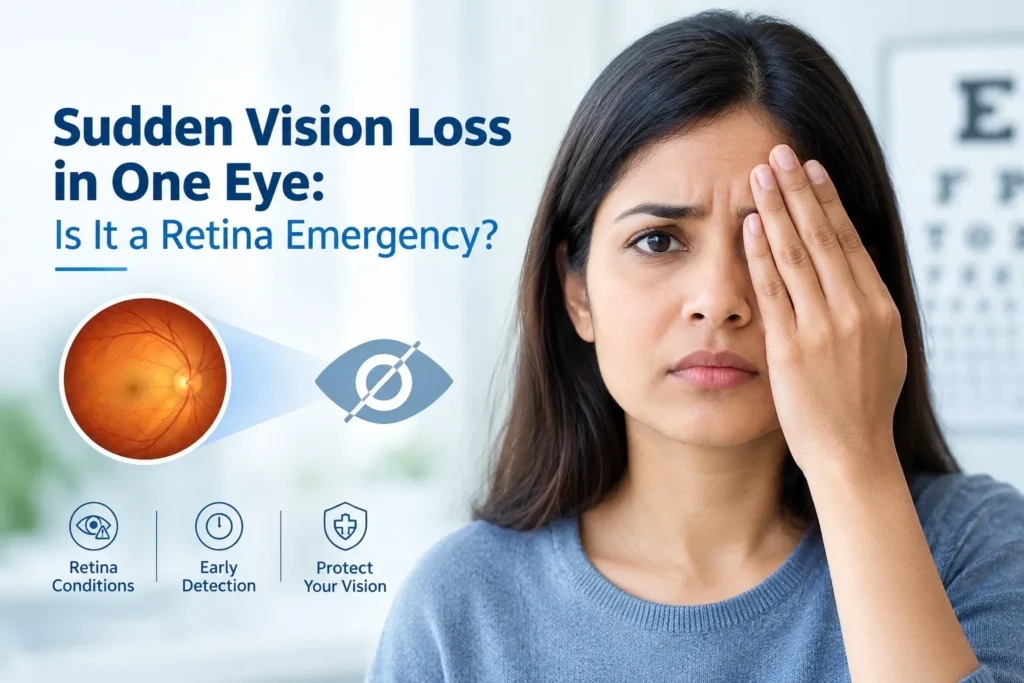
You cover one eye and the other side of the world looks dim, smudged or partly missing. Sudden loss of vision in one eye is frightening, and the urge to “sleep on it” is understandable. It is also risky.
So, is it a retina emergency? Often, it can be. Treat sudden vision loss in one eye as urgent until an eye professional says otherwise. Causes such as retinal detachment or a blocked retinal blood vessel can lead to permanent damage if assessment is delayed. Not every case is a retina problem, but only an examination can tell the difference.
Sudden Loss of Vision in One Eye – Why Can It Happen?
The retina is the thin, light-sensing layer at the back of the eye. It needs steady blood supply and a firm attachment to the eye wall, so trouble with either can change vision within minutes or hours. Possible causes include:
- Retinal detachment – the retina pulls away from the tissue beneath it.
- Retinal artery occlusion – a blocked artery feeding the retina. It can be linked to wider circulation problems.
- Retinal vein occlusion – a blocked retinal vein, causing swelling and bleeding.
- Vitreous-related problems – bleeding into, or pulling from, the gel inside the eye.
- Optic nerve causes – such as optic neuritis or reduced blood flow to the nerve.
- Other emergencies – including acute angle-closure glaucoma or events in the brain.
Retina Problems Symptoms You Should Not Ignore
The retina has no pain nerves, so serious retinal trouble is often painless. Warning signs include:
- Sudden loss of vision, partial or complete
- Flashes of light
- A sudden increase in floaters (specks or cobwebs drifting across your sight)
- A curtain or shadow across vision
- Sudden blurry or distorted vision, such as wavy straight lines
- Missing areas in the visual field
If these appear suddenly, especially together, you need assessment the same day.
When Is Sudden Vision Loss a Retina Emergency?
Treat it as an emergency if vision drops abruptly, a shadow appears, or flashes and floaters arrive suddenly. A detached retina is time-sensitive: the longer it stays separated, the lower the chance of recovering lost vision. A blocked retinal artery starves tissue of oxygen, so damage can progress quickly. Seek urgent care for:
- Sudden vision loss in one eye, even if brief or partial (brief loss can still warn of a circulation problem)
- A new curtain, veil or dark shadow
- Sudden flashes with new floaters
- Vision loss with eye pain, severe headache, weakness or difficulty speaking
When Should You See a Retina Specialist?
A retina specialist is an ophthalmologist with extra training in diseases of the retina and vitreous, such as detachments, vascular blockages, and macular conditions. A general eye examination is a sensible first step; if findings suggest a retinal cause, a detailed retinal assessment may follow.
Families often search for a retina specialist in Indore, or a top eye specialist in Indore. In an emergency, the better question is who can examine the retina quickly and arrange further care. At RK Eye & Retina Center, patients with sudden visual changes can be assessed for retinal causes and guided on next steps.
How Is Sudden Vision Loss Evaluated?
The doctor usually begins with your history: when it started, any flashes, and conditions such as diabetes or high blood pressure. Tests may then include:
- Dilated retinal examination – drops widen the pupil so the retina and optic nerve can be inspected. Bring someone with you, as vision stays blurry for a few hours.
- OCT (optical coherence tomography) – a quick, non-contact scan showing retinal layers, swelling or fluid.
- Retinal imaging – photographs or dye-based studies of blood vessels.
- Eye pressure measurement – useful when glaucoma is possible.
- Other tests – chosen according to symptoms and findings, since no single test suits everyone.
Treatment Depends on the Cause
Because causes differ, treatment is never one-size-fits-all. Depending on the diagnosis, it may include:
- Injections to reduce swelling or abnormal vessel growth
- Laser treatment to seal retinal tears
- Medicines, along with control of diabetes or blood pressure
- Surgery for problems such as retinal detachment
- Observation in selected situations
Outcomes vary, and no clinic can promise a particular result. If surgery may be needed, people often look for a retina surgery specialist hospital in Indore; ask about imaging, operating capability and follow-up before deciding.
Why Choosing the Right Eye Care Team Matters?
With sudden vision loss, timing and accuracy matter most. When comparing an Eye Hospital in Indore, ask whether dilated examination, OCT and retinal imaging are available and whether the team explains findings clearly.
Rather than chasing the Best Retina Eye Treatment in Indore as a label, look for evidence-based care matched to your diagnosis. Good eye care services in Indore should cover diagnosis, treatment planning and follow-up. RK Eye & Retina Center aims to help patients understand their symptoms, complete the right tests and decide on treatment with their doctor.
Pro Tip: If vision suddenly becomes significantly worse in one eye, especially with flashes, new floaters, a curtain-like shadow or missing vision, do not wait for the symptoms to settle on their own. Seek prompt professional eye evaluation.
Key Takeaways
- Sudden vision loss in one eye should be treated as urgent until examined.
- Retinal detachment, vessel blockage and optic nerve problems are possible causes.
- Flashes, new floaters, a curtain-like shadow and distortion are warning signs.
- A dilated examination and OCT help identify the cause.
- A retina specialist may be needed when findings suggest a retinal problem.
- Treatment depends on the diagnosis, and early assessment helps protect vision.