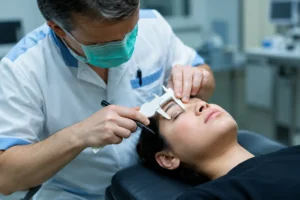
Many people assume their glasses number is too high, their corneas too thin, or their eyes too dry for laser correction. Having one of these conditions does not automatically rule out LASIK, and it does not guarantee you will qualify either. Suitability differs from person to person and can only be confirmed after a detailed eye examination.
What Determines LASIK Eligibility?
LASIK eligibility is never decided by a single number. Doctors look at the whole picture, including:
- Whether your eye power has been stable
- Corneal thickness and shape
- Overall corneal and eye-surface health
- Dry-eye symptoms
- General eye health, age and medical history
These findings are read together with diagnostic test results, so two people with the same prescription can receive very different advice.
LASIK for High Eye Power – Is It Possible?
There is no fixed prescription number that works as a cut-off for everyone. A higher power means more corneal tissue must be reshaped, so the assessment becomes more detailed. Whether LASIK for high eye power is possible depends on corneal thickness and shape, whether your prescription has stopped changing, and how much correction is needed. Some patients with high power may be considered, while others may be guided toward a different option.
LASIK for Thin Corneas – What Patients Should Know
Laser correction removes a small amount of corneal tissue, and the cornea must retain enough strength afterwards to stay stable. That is why doctors measure thickness carefully and check whether enough tissue can safely remain. LASIK for thin corneas is not suitable for every patient. A thin reading does not always mean rejection, but where tissue reserve is limited, the doctor may discuss other vision-correction procedures instead.
LASIK for Dry Eyes – Can You Still Be a Candidate?
Laser treatment can temporarily worsen dryness in some people, so doctors take existing symptoms seriously. Severity, tear-film stability, and the condition of the corneal surface all influence the decision. LASIK for dry eyes may be considered once symptoms are well managed, and sometimes treatment is advised first to improve the eye surface. If dryness is significant, your doctor may suggest waiting or choosing another route.
What Tests Are Done Before LASIK?
Tests vary from patient to patient, but commonly include:
- Refraction and prescription assessment
- Corneal thickness measurement
- Corneal mapping (topography)
- Tear-film and dry-eye evaluation
- Pupil assessment
- A general eye examination
At RK Eye & Retina Center, this kind of assessment helps the specialist explain whether you may be a candidate for LASIK eye treatment in Indore, or whether another approach suits you better.
When LASIK May Not Be the Right Option
LASIK may not be advised when the prescription is still changing, when there are corneal abnormalities, when dry eye is significantly uncontrolled, or when other eye-health concerns are present. In such cases, alternative procedures are sometimes considered, and a careful choice is what keeps laser eye surgery in Indore matched to your eyes rather than to a package.
Choosing the Right Eye Specialist for LASIK Surgery in Indore
When comparing options for LASIK surgery in Indore, price alone is a poor guide. Look for an experienced eye specialist, properly equipped diagnostics, a thorough pre-operative assessment, and honest counselling, including being told when surgery is not advisable.
Many people search for the Best Lasik Eye Surgery Doctor Indore, but the right choice is the one who examines you carefully and explains your options clearly. A dependable Eye Hospital in Indore should offer complete testing in one place. RK Eye & Retina Center is a professional eye-care center where you can be evaluated and discuss your suitability with an eye specialist. Whichever centre you shortlist as the Best Eye Hospital in Indore, ask how decisions are made.
Pro Tip
Pro Tip: Do not decide whether you are suitable for LASIK based only on your glasses number. A detailed eye examination is essential because corneal thickness, shape, tear-film health, and prescription stability can all influence the decision.
Key Takeaways
- High eye power does not automatically rule out laser vision correction.
- Thin corneas require careful evaluation before any decision.
- Dry eyes may need to be managed before surgery.
- LASIK suitability varies from person to person.
- A complete pre-operative assessment is essential.