
Turning 40 often comes with a small but familiar change: holding the menu a little further away to read it clearly. If you’ve also been considering LASIK for years, you might assume that window has closed. It hasn’t, at least not automatically. Being over 40 doesn’t disqualify you from LASIK, but the evaluation looks a little different, because age-related changes in near vision become an important part of the conversation.
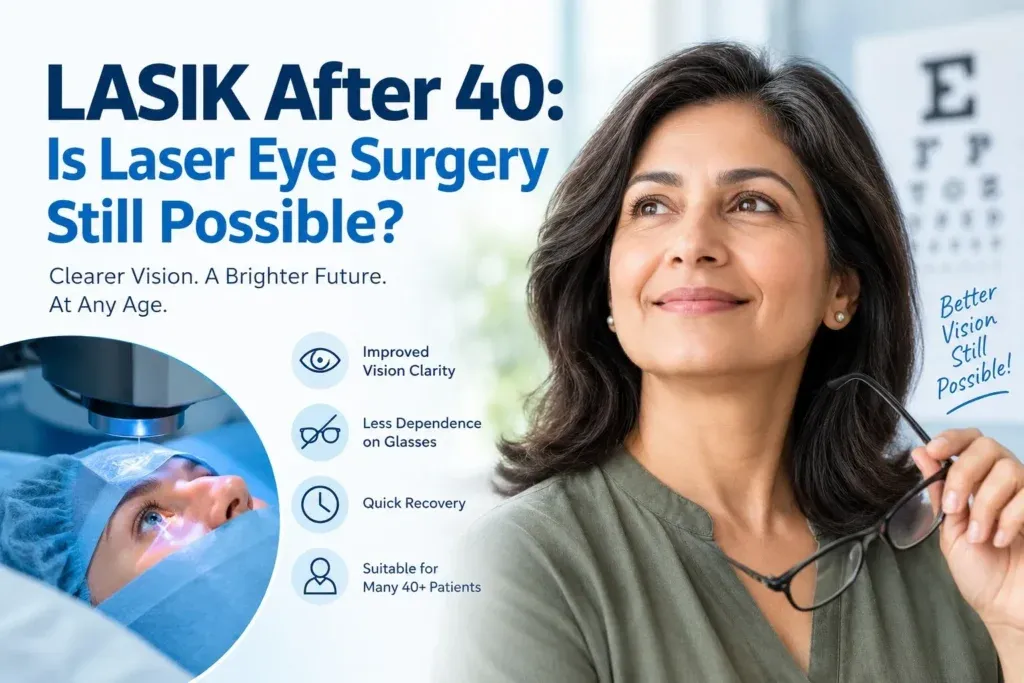
Is LASIK Possible After 40?
Yes, many people in their 40s can still be reasonable candidates for LASIK. Age alone isn’t disqualifying – what matters more is a stable prescription, a healthy cornea, and the absence of untreated eye disease.
This is exactly why a comprehensive eye examination matters at this stage. It helps determine whether your vision changes are purely refractive (nearsightedness, farsightedness, astigmatism) or linked to normal aging, such as the gradual loss of near focusing ability, which LASIK cannot address.
What Changes in Your Eyes After 40?
Several natural changes tend to appear around this age:
- Presbyopia – the eye’s lens becomes less flexible, making close-up focusing harder.
- Near-vision changes – people who never needed glasses start reaching for reading glasses.
- Dry-eye symptoms – tear quality can decline, causing dryness or fluctuating vision.
- Prescription shifts – distance or astigmatism prescriptions may change slightly.
- Other conditions – early cataract changes may become more relevant.
These changes are common, and they shape what LASIK can realistically achieve.
LASIK and Presbyopia: What You Need to Know
This is one of the most misunderstood aspects of LASIK after 40. Standard LASIK reshapes the cornea to correct distance-vision errors. Presbyopia, however, comes from changes within the eye’s natural lens, not the cornea.
That means someone can have excellent distance vision after LASIK and still need reading glasses for close work. LASIK doesn’t stop or reverse the natural aging of the lens. Depending on your eyes and lifestyle, your ophthalmologist may discuss alternative or complementary approaches, such as monovision techniques, during your consultation.
Also Read: LASIK Eye Surgery in Indore: Who Is a Good Candidate for Treatment?
What Is the Best Age for LASIK Surgery?
Patients often search for the best age for LASIK surgery expecting one clear answer, but there isn’t a single number that fits everyone. Specialists look for a stable prescription, healthy corneal thickness, and no active eye disease, regardless of whether the patient is 25 or 45. Younger adults are usually evaluated for prescription stability, while patients over 40 also need assessment of presbyopia and tear-film health. Eye health matters more than a birthday.
Who May Be a Candidate for LASIK After 40?
Ophthalmologists typically consider:
- A prescription that has stayed stable for at least a year
- A cornea that is healthy and adequately thick
- Good tear-film quality without significant chronic dry eye
- No significant eye disease, such as advanced glaucoma or retinal disorders
- Realistic expectations about what LASIK can and cannot correct
Only a qualified ophthalmologist can confirm individual suitability after a full eye health review.
When LASIK May Not Be the Best Option After 40
In some cases, a doctor may suggest alternatives – for example, if there’s noticeable unmanaged dry eye, corneal irregularities, a prescription still in flux, early lens changes, certain retinal conditions, or presbyopia significant enough to affect daily near-vision tasks. This is general information, not a diagnosis; only an in-person exam can tell you which situation applies to you.
LASIK Surgery in Indore: Why a Detailed Evaluation Matters
If you’re researching LASIK surgery in Indore, look past the advertisements and focus on the evaluation process itself. A responsible clinic prioritizes a qualified ophthalmologist, detailed pre-operative testing, corneal mapping, and honest discussion of risks, benefits, and alternatives. At RK Eye & Retina Center, this kind of assessment comes first, so patients understand what to expect before deciding on treatment.
How to Choose the Best LASIK Eye Surgery Doctor in Indore
Finding the best LASIK eye surgery doctor Indore has to offer isn’t about picking the top search result. Look at the surgeon’s qualifications and experience, the diagnostic technology used for pre-surgical testing, how clearly candidacy is explained, and the approach to follow-up care. A good consultation, such as the one you’d expect at a center like RK Eye & Retina Center, should feel like a conversation, not a sales pitch.
LASIK Eye Surgery in Indore: Questions to Ask Before Surgery
Before committing to LASIK eye surgery in Indore, walk into your consultation with clear questions:
- Am I a suitable candidate based on my eye health?
- Is my current prescription stable?
- Do I show early signs of presbyopia?
- What should I expect for my near vision after treatment?
- Are there alternatives better suited to my eyes?
- What follow-up care will I need afterward?
Pro Tip: Never choose a laser vision correction procedure based on price alone. Ask for a complete explanation of your candidacy, your expected outcome, the risks involved, and any alternatives that might suit your eyes better.
Key Takeaways
- Turning 40 doesn’t automatically disqualify you from LASIK.
- Presbyopia and other age-related changes make individualized evaluation important.
- LASIK corrects distance-vision refractive errors but doesn’t stop natural lens aging.
- Candidacy depends on corneal health, prescription stability, and tear-film status.
- A detailed pre-operative exam is the only reliable way to know your options.
- Choosing a facility with proper diagnostics matters more than marketing claims.
Best Eye Hospital in Indore: What Should Patients Look For?
When comparing options for the best eye hospital in Indore, look beyond convenience or advertising. Consider the diagnostic equipment available, the experience of the ophthalmologists, the surgical infrastructure, and how clearly staff communicates. An eye surgery hospital in Indore that invests in thorough pre-surgical evaluation is generally better positioned to guide patients toward the right decision, whether that’s LASIK or another option. RK Eye & Retina Center approaches consultations with this evaluation-first philosophy, helping patients understand their own eyes before recommending any treatment path.
If you’re considering LASIK after 40, the most reliable next step is a comprehensive eye evaluation with a qualified ophthalmologist. RK Eye & Retina Center offers detailed consultations to help you understand which options genuinely suit your eyes. You can book an appointment at https://rkeyehospital.com/appointment-booking/ or call +91-7024154321 to schedule a consultation and discuss your vision-correction goals.