- info@rkeyecenter.com
- Call Us +91-7024154321 | +91-7312705058
Keratoprosthesis (Artificial Cornea) Evaluation in Indore
जटिल कॉर्नियल रोगों और बार-बार असफल कॉर्नियल ट्रांसप्लांट के बाद चयनित मरीजों के लिए विशेषज्ञ मूल्यांकन
Keratoprosthesis is an advanced surgical option that may be considered for selected eyes when a conventional corneal transplant has repeatedly failed or may have a low likelihood of success. At RK Eye & Retina Centre, suitability is assessed through coordinated cornea, retina and glaucoma evaluation.
Treatment suitability is decided only after detailed clinical evaluation.
- Specialist-led cornea evaluation
- Retina and glaucoma assessment support
- Detailed patient selection and counselling
- Long-term follow-up planning
Featured in Dainik Bhaskar, Swatantra Samay and Vinay Ujala
What is Keratoprosthesis or an artificial cornea?
Keratoprosthesis is a specialised artificial cornea procedure designed for selected, highly complex eyes. It is different from a routine corneal transplant and is generally discussed only when a conventional donor-cornea transplant has failed repeatedly or is unlikely to provide a suitable long-term option.
The procedure places an optical component within a donor corneal tissue framework. Before it can be considered, the treating team must assess the ocular surface, retina, optic nerve, eye pressure, previous surgeries and the patient’s ability to continue long-term follow-up.

When may Keratoprosthesis evaluation be discussed?
A specialist evaluation may be appropriate in selected situations such as:
- Repeated failure of a conventional corneal transplant
- Severe corneal scarring or opacity with limited conventional options
- Chemical or complex ocular-surface injury
- Eyes where another donor-cornea transplant may have a low likelihood of durable success
- Complex cases requiring coordinated cornea, retina and glaucoma assessment
Complex corneal surgery requires more than cornea expertise alone
In complex eyes, the clarity of the cornea is only one part of the decision. The potential benefit of surgery also depends on the health of the retina, optic nerve, eye pressure and the ocular surface.

Cornea evaluation
Diagnosis, surface assessment, previous graft review, case selection and surgical planning.
Retina evaluation
Assessment of posterior-segment health, visual potential and any retinal condition that may limit outcome.
Glaucoma evaluation
Eye-pressure assessment and long-term monitoring where required.
Continuity of care
Counselling, realistic expectation-setting and regular long-term follow-up.
Specialist leadership

Cornea-led case evaluation
Dr Trushaa Agrawal
Leads the cornea assessment for complex corneal disease, including review of previous transplant history, ocular-surface status, suitability testing, surgical counselling and long-term cornea follow-up.
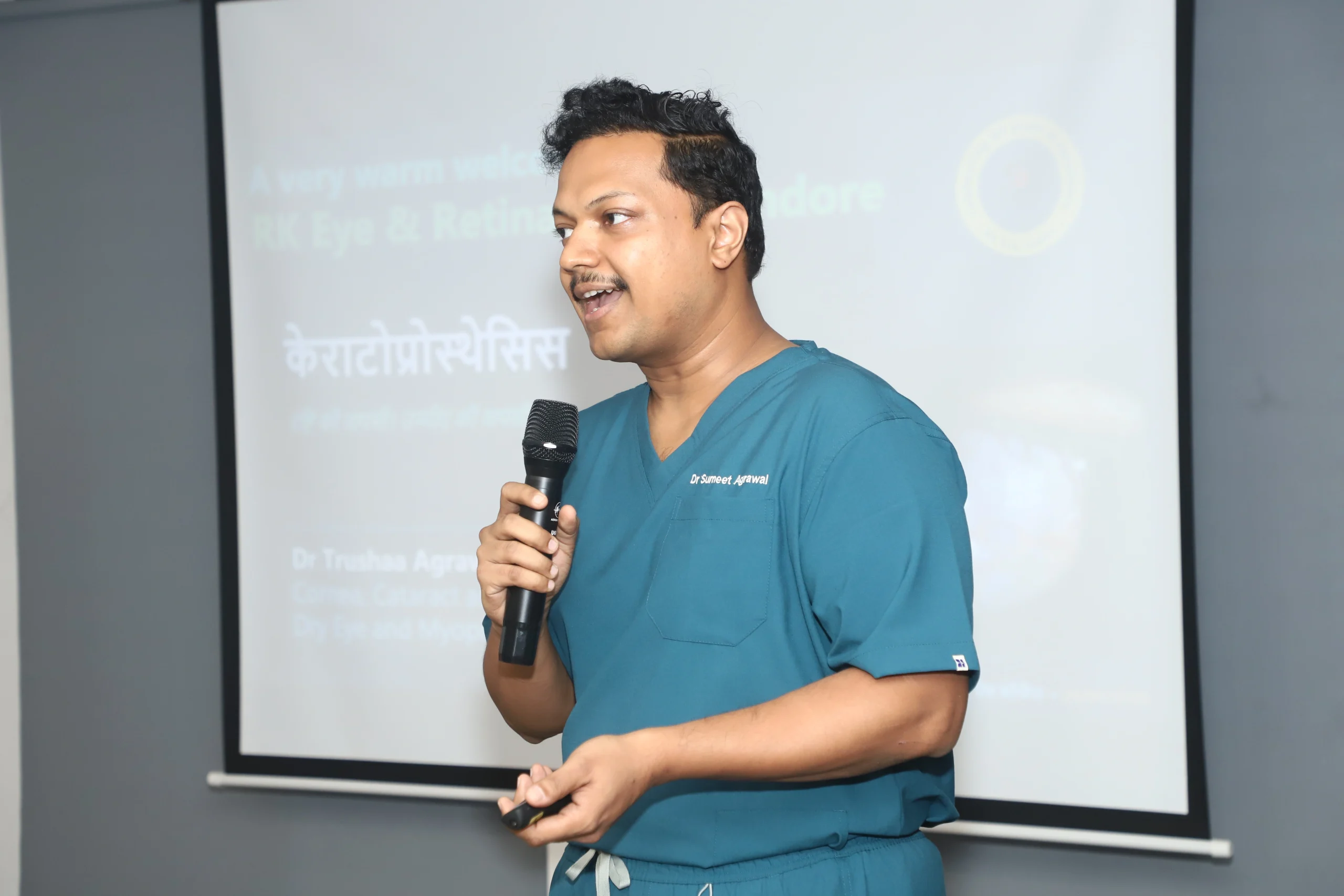
Retina assessment in complex corneal cases
Dr Sumeet Agrawal
Provides retina and vitreoretinal evaluation where the condition of the posterior segment may influence visual potential, treatment planning or long-term follow-up.
Evaluation journey
History review
Previous corneal procedures, operative notes, medical conditions and current symptoms.
Cornea & ocular-surface examination
Assessment of corneal opacity, scarring, graft status and surface health.
Retina & optic-nerve assessment
Evaluation of posterior-segment health and potential factors limiting vision.
Eye-pressure & glaucoma assessment
Testing and monitoring plan where clinically indicated.
Suitability & counselling
Discussion of realistic benefits, limitations, risks, alternatives and follow-up requirements.
Treatment & long-term follow-up plan
A personalised pathway is prepared only when clinical findings support it.

Clinical awareness and media interaction at RK Eye & Retina Centre, Indore — July 2026.
Building awareness around complex corneal treatment options
The July 2026 clinical and media interaction at RK Eye & Retina Centre focused on Keratoprosthesis, patient selection, multidisciplinary assessment and the importance of timely referral in severe corneal disease.
The objective was not to present surgery as suitable for everyone, but to help patients, families and referring clinicians understand that selected complex cases may still deserve an advanced specialist opinion.
Keratoprosthesis work at RK Eye featured in local media
The centre’s clinical work and awareness initiative were reported by Dainik Bhaskar, Swatantra Samay and Vinay Ujala in July 2026. The reports highlighted access to advanced artificial-cornea evaluation in Indore and the role of coordinated cornea, retina, glaucoma and long-term follow-up support.


Dainik Bhaskar
28 July 2026
Coverage on complex artificial cornea surgery giving selected patients a new treatment pathway to consider.
Swatantra Samay
25 July 2026
Report on Keratoprosthesis surgery evaluation being made available in Indore.
Vinay Ujala
25 July 2026
Detailed report on the multidisciplinary approach and complex corneal-care pathway.
When a complex cornea second opinion may help
- A previous corneal transplant has failed more than once.
- You have been told that another transplant may not succeed.
- The cornea is opaque, but the condition of the retina or optic nerve is unclear.
- You need to understand whether an advanced surgical option may be clinically possible.
- You want a coordinated cornea, retina and glaucoma assessment before deciding the next step.
FAQ Schema Content
Frequently asked questions
Keratoprosthesis is a specialised artificial cornea procedure considered in selected complex eyes when a conventional corneal transplant has repeatedly failed or may be unlikely to provide a suitable long-term option.
No. A routine transplant uses donor corneal tissue to replace the damaged cornea. Keratoprosthesis uses an optical prosthetic component within a corneal tissue framework and requires different case selection and long-term monitoring.
Selected patients with repeated graft failure, severe corneal scarring, complex ocular-surface damage or limited conventional options may be evaluated. Suitability can be decided only after detailed examination.
No. Visual outcome depends on the retina, optic nerve, glaucoma status, ocular surface and other clinical factors. No particular result can be guaranteed.
A clearer optical pathway can help only when the retina and optic nerve have sufficient visual potential. Retina assessment therefore forms an important part of planning in many complex cases.
Eye-pressure assessment and long-term glaucoma monitoring may be necessary because pressure-related damage can influence visual outcome and follow-up planning.
Keratoprosthesis requires structured, long-term and often lifelong monitoring. The exact schedule is decided by the treating team.
Bring previous operative notes, corneal transplant details, eye-pressure records, retina scans, current prescriptions and any relevant reports available with you. Additional investigations may be advised after examination.
No. Many corneal conditions are better managed with other medical or surgical options. Keratoprosthesis is considered only after a detailed suitability assessment.
Call or WhatsApp RK Eye & Retina Centre on +91 70241 54321 and request a Cornea Specialist Evaluation or Complex Cornea Second Opinion.
Complex corneal condition? Begin with specialist evaluation — not assumptions.
If you have severe corneal opacity, a repeatedly failed corneal transplant or an unclear treatment pathway, schedule a coordinated specialist assessment at RK Eye & Retina Centre, Indore.
📞 +91 70241 54321 | 📍 138, Jaora Compound, Indore, Madhya Pradesh
Treatment suitability depends on clinical evaluation. Results may vary. This content is for awareness and does not replace medical consultation.
R.K. Eye & Retina Centre — 138, Jaora Compound, Indore, Madhya Pradesh | +91 70241 54321 | rkeyehospital.com
Our Treatment
- Cataract Surgery in Indore
- Retina & Vitreous Surgery in Indore
- LASIK & Refractive Error Correction in Indore
- Glaucoma Diagnosis & Laser Treatment in Indore
- Pediatric Ophthalmology in Indore
- Optical Outlet & In-house Pharmacy in Indore
- Diabetic Retinopathy Treatment Indore
- Dry Eye & Eye Allergy Treatment in Indore
- Retina Services in Indore
- Pediatric Myopia Treatment in Indore
Contacts
- Jaora Compound, Opp. M.Y. Hospital, Indore
- +91-7024154321
- +91-7312705058
- info@rkeyecenter.com
-
Mon–Sat: 9 AM–8 PM
Sun: 9 AM–5 PM - 24x7 on-call support

All Right Reserved